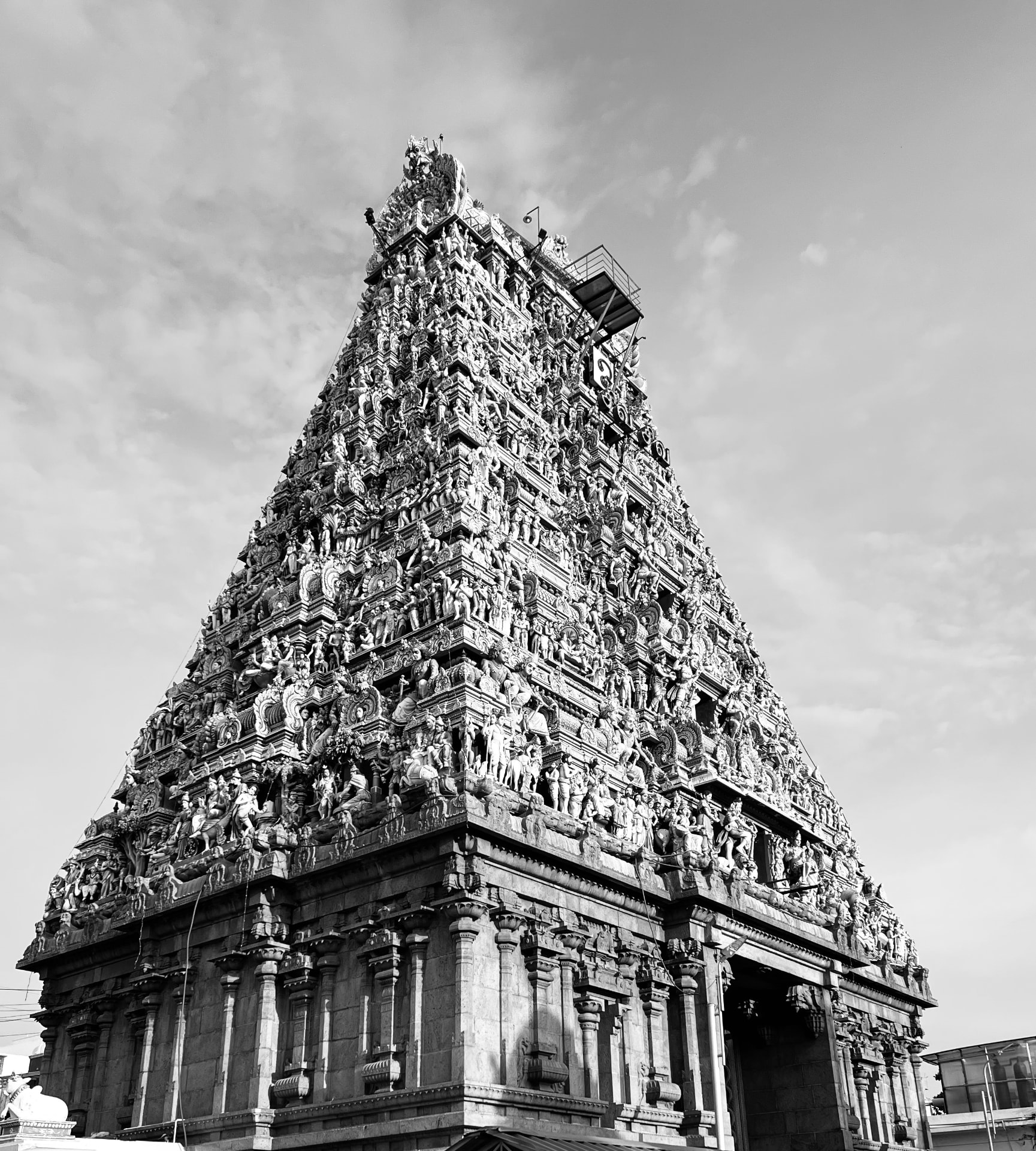
From an earlier draft
The Houses We Inherit
An early version of the novel's opening. The manuscript has since been substantially revised, but this passage offers a glimpse into Sandhya's world and the beginnings of The Seventh House.
Sandhya
When I look back at my life, I think of houses. And then I find, if I were to break my life into phases, it divides itself neatly, across the three spaces that I called my home.
The first of the houses, was perhaps the most loved. Or, at any rate, I pretend that it was the most loved. Everyone in my family does, even as they attribute nostalgia to where there is none. Gomathi Illam, was our two-storeyed mansion in the middle of Tyagaraja Nagar, with a much envied mango tree that had grown rather wildly and offered low hanging fruits to the passer-by. Gomathi Illam, named after my paati, was perhaps not as massive as my childhood memory suggests. But, over the years, from the one-thousand eight hundred square foot space it actually was, it began to assume gigantic proportions.
“You lived in the T Nagar palace, va?” Raju, my friend from college would often ask me when I would narrate tales about times when we didn't think for a second as we ran up and down the stairs. In fact, for all purposes, Gomathi Illam was a palace. Our palace. Gomathi Paati loved telling us about the royal kitchen that had to run in the house and the daughters-in-law she lorded over.
“All day long, I would make the whitest of dosais and brew the freshest of kaapis,” she would sigh, as if even the thought of those days was enough to tire her and make her use her sari end to fan herself. If Paati's measure of her nostalgia were the sixty-five dosais that she tirelessly made for the ever hungry stomachs in the house, Thatha remembered his chair. Moorthy Thatha's chair, the one that was made with high-quality cane and that sat ominously on the verandah, sometimes welcoming and often suspicious of anyone who as much as walked along our fence. The chair, offered Moorthy Thatha the best vantage point view of the street and mango thieves were kept at bay. The chair was a bright orange and clashed violently with Thatha's pristine white all-year-round ensemble. If Gomathi Illam was the palace, the chair was indeed the emperor's seat. Thatha spent most of the day sitting on that chair, often, he would catch up on his afternoon nap while sitting on the chair. At such times, Paati would, rather violently wake him up from his sleep and demand that he go and sleep in his bedroom.
“What will everyone think, hanh? You sleeping at the entrance of the house,” Paati would say.
Thatha would at first deny that he was sleeping at all. After which, he would proceed to explain the joy of sleeping while sitting on his favourite chair. And finally end with the, this is my house and I will do as I please. Nobody argued with that. It was indeed Moorthy Thatha's house. Moorthy Thatha worked in one of the oldest companies in Madras – The Madras House, it was called. Nobody was sure what is it that the company actually made. But, Moorthy Thatha worked there for thirty-three years and at the age of fifty-eight, called it quits. At that age, Thatha had hoped to enjoy living in his massive house.
I used to love Gomathi Illam. Not so much for the mango tree, or the large amount of space that was available to us, or the fact that we had all of the family living together under one roof. I didn't see the Great Indian Family as a joyous legacy. Our lives were far from perfect. Thatha was always picking fights with his sons. The brothers vehemently argued about everything. The sisters, who were regular visitors brought with them sorrowful tales of marital discord. Somebody or the other was always pregnant. The children were always hungry. No, we were an imperfect family. But, that is what I loved. I loved how we didn't strive to or foolishly hope that things would magically fall into place. In our angst, in our fights, in our discord, in our insecurities, we found our common ground and happiness. As a child in this house, I got very little attention from both Amma and Appa.
In fact, every year, Appa would ask me, “which class is it that you are in, again?” They were not bad parents. They were merely imperfect parents. And I was happy then.
Things changed when I turned twelve. Shivam Thatha, our next door neighbour, died in his sleep. Understandably, Thatha was shaken and scared. While, he often made jokes about the inevitably of his death and had an almost morbid fascination for the subject, he never believed that it was so real and this near. Thatha was healthy and at seventy, not so old, but the fear had set in. Somehow, things changed after that. Thatha was more resigned, quieter, less prone to picking fights with his children. It was like, he had suddenly aged by twenty years. Along with Shivam Thatha's death came an ugly battle for the house among his children. This was not surprising. Many families around us didn't see much merit in carrying forward a legacy of living in and managing a large house. Maids were beginning to charge per task. Water was never enough. Toilets required you to bend your knees and squat. And not everybody wanted to eat rasam and roasted appalam everyday. The year was 1995, the shops had begun to sell things that we hadn't heard about before. Everyone had begun to have some money for the first time in their lives. It was the time to let go, to get over this unexplained attachment that one had for land and unmanageable homes. Moorthy Thatha, Appa, Periappa and Chitappas watched with some horror and fascination as Om, Shivam Thatha's house was pulled down by a property developer.
Perhaps it was the fear of the possibility of an ugly battle in our house that prompted Thatha to sell Gomathi Illam too. The brothers protested, but it was a weak one and for the period that our new flats would take to get ready, alternative arrangements were made. I suddenly found myself, moving away from a family of twenty-five to five. Our stop-gap home was on the street parallel to Gomathi Illam. We lived on the second floor of an apartment that called itself – Park View. Natesan Park, probably the one that they were alluding to, was a good three kilometers away. It was a very tiny flat and that forced an intimacy among all of us. Suddenly, Amma knew every little detail about me. About how I was doing in school, about the boys in my class, the dresses that I hid at the bottom of the shelves and never wore, how many biscuits I ate, how many times I used the bathroom. Every little thing. I was thirteen. I resented it. However, by far the most worrying change in Amma was in her newfound belief in stars, planets and assorted Gods. Days began to be set aside for prayers. All problems, small and big had a pariharam, a solution, either to bypass the problem or overcome it. If Amma did all of this without demanding our involvement in it, that would have been fine. But that wasn't to be. Some days, she made me chant a few verses in a language that I could read but not understand. There were days when she demanded that I eat a certain type of food. Some days we went to a dingy temple and lit a lamp. Many of these were regular, some so bizarre that I found myself congratulating the one who had originally thought of this on his ingenuity. Amma and her loyal set of three friends, faithfully tried out all these divine activities on us.
I liked the Park View house for only one thing, it opened up to the main road. Back then, T Nagar wasn't anywhere near as chaotic as it is today. There were a few shops and all of them very small and selling odd things. There were a few tiffin houses, some hardware stores and some silver merchants. I would stand in our balcony and watch the stores and the people. This till Amma would shout and ask me to stop whiling away my time. Right across our house was Ramya's Iyengaar Bakery, my most loved shop on the street. Every time that I got some money, Sharan and I would run across the street and eat a cream roll. The sickly sweetness and pungent essence has to be my happiest childhood memory.
Three years later, our flat got ready and that is when we moved into our third house. The house that is my home today. At least, the house that I call my home. Bharat Anna had left home by now and we were now a family of four. We had the extended family for neighbours. Owning five of the sixteen flats in the apartment gave us a lot of clout, as we threw around our weight and made all kinds of demands on our other tenants. In many ways, it was like being back in Gomathi Illam, except that we didn't all have to eat the same food each day.
This house, Flat No 202, I have never liked. Somehow, it has never felt like home. The building was painted grey, even if ironically our building was named Ruby Gardens. The insipidness of the exterior, carried inside the house too. The fittings were inappropriate, lacking aesthetics and cheap. While Periappa and Chitappas completely refurbished their homes, Appa and Amma chose to keep it this way. The ordinariness of this house, mirrored the ordinariness of our lives. With Bharat Anna gone on his quest for academic excellence, Amma and Appa turned their attention towards me. I was not a bad student, but I wasn't very good either. I didn't have any ambition. Didn't peruse any interests and could watch television all day. Understandably, Amma was worried. The family astrologer was consulted and my horoscope was drawn. Guru, was weak, the Astrologer Maama had said. Some pariharams followed. This didn't help very much. The planets are all awry, Astrologer Maama said during Amma's next visit. A pilgrimage to the Navagraha Temples were undertaken. Amma didn't see any change in me even after this. Not for a moment willing to concede that I could just be ordinary, Astrologer Maama was dumped and a new Astrologer Maami from Mambalam, called Saraswathi Maami was consulted. Saraswathi Maami said that I was plagued by the Saturn God and that was contributing to all my woes. It is very bad period till she turns twenty-five, Saraswathi Maami said. However, several poojais were recommended to weaken the grip of Saturn on my fortunes.
Through all of this, I remained an observer. Wistfully thinking back of the times in Gomathi Illam, when we were all so much at peace with our imperfections.
And then, when I turned twenty-four, I discovered yet another house – the Seventh House.